
Hazard statement · Physical hazards
What does H250 mean?
Catches fire spontaneously if exposed to air.
- Hazard class
- Pyrophoric Liquids, Hazard Category 1; Pyrophoric Solids, Hazard Category 1 (Pyr. Liq. 1 / Pyr. Sol. 1)
- Pictogram
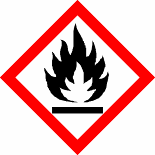 GHS02Flame
- Signal word
- Danger
Categories and label elements
| CLP abbreviation | Pictogram | Signal word |
|---|---|---|
| Pyr. Liq. 1 | GHS02Flame | Danger |
| Pyr. Sol. 1 | GHS02Flame | Danger |
Related precautionary statements (P codes)
The precautionary statements that CLP Annex IV assigns to this class. Not all of them go on the label: under CLP Article 28(3), no more than six precautionary statements appear on the label unless the nature and severity of the hazard require more; the selection depends on the product and its users.
Prevention
Response
- P302+P334IF ON SKIN: Immerse in cool water or wrap in wet bandages.
- P370+P378In case of fire: Use… to extinguish.
- P302+P335+P334IF ON SKIN: Brush off loose particles from skin. Immerse in cool water [or wrap in wet bandages].
Build a label with this class. The free label tool works out the pictogram, the signal word and the P statements for the label from the classes you choose.
Where is H250 written in the SDS?
H250 is tracked in three places of the SDS: the classification line in Section 2.1 ("Pyr. Liq. 1 / Pyr. Sol. 1"), the label elements in Section 2.2 and the component list in Section 3. Section 16 repeats the explanation of the code. In addition, it must agree with the physical and chemical properties in Section 9 and, if the product is subject to transport rules, it is read together with the ADR information in Section 14.
How does H250 appear on the label?
The label elements for H250 are: pictogram GHS02 (flame); it is written with the signal word "Danger". In the Chemoris template Section 2.2 carries at most 8 H statements; if the limit is exceeded the least severe ones are dropped and a warning is shown. For the bottom of the label, 6 P statements are candidates for this class in CLP Annex IV; under CLP Article 28 at most 6 of them are selected.
Where does it appear in the safety data sheet?
- Section 2.1: classification; the class abbreviation and H250 are given together.
- Section 2.2: label elements; H250 with its full text, pictogram and signal word.
- Section 3: composition table; in the row of every component that has this class.
- Section 16: the full text of the H statements cited as codes in earlier sections.
Class criteria and thresholds for H250
The values below come from the Chemoris rule file (CLP Annex I). They show the condition under which H250 arises in a mixture. For physical hazards and other classes that depend on test data, the result comes from the mixture's own measurement, not from component percentages.
The class behind H250 depends on the mixture's own test data; the Chemoris rule file does not derive it from component percentages and warns the chemist when a component carries it (≥ 1 %) (CLP Annex I 2.x (for physical hazards 1.1.1.3 / Article 6(5) data requirement); 2.16.3 (metal-corrosive mixture)).
H250 compared with H251 and H252
The table below puts H250 next to its closest neighbouring statements; the values are read from the rule data.
| Hazard statement | H250 | H251 | H252 |
|---|---|---|---|
| Class abbreviation | Pyr. Liq. 1 / Pyr. Sol. 1 | Self-heat. 1 | Self-heat. 2 |
| Pictogram | GHS02 | GHS02 | GHS02 |
| Signal word | Danger | Danger | Warning |
| Precautionary statements assigned | 6 | 5 | 5 |
| Concentration cut-off in a mixture | — | — | — |
H250 and H251 carry the same signal word (Danger). Both are shown with the same pictogram (GHS02). The signal word differs: Danger for H250, Warning for H252. Both are shown with the same pictogram (GHS02).
In which SDS sections does H250 appear?
H250 does not stay only in the label section of an SDS; the class itself and the precautionary statements assigned to it shape the content of other sections too. The counts are calculated from the P statements that Annex IV assigns to this class.
| SDS section | Relation to this code |
|---|---|
| 2.1 Classification | Written with the abbreviation Pyr. Liq. 1 / Pyr. Sol. 1 and the code H250. |
| 2.2 Label elements | H250 appears with its full text, GHS02 (flame) and “Danger”. |
| 3 Composition | The class and code show in the row of every component that carries this class. |
| 9 Physical and chemical properties | The classification has to agree with properties such as flash and boiling point given here. |
| 4 First aid | Of the 6 assigned P statements, 2 belong to the subject of this section: P302+P334, P302+P335+P334. |
| 5 Firefighting | Of the 6 assigned P statements, 1 belong to the subject of this section: P370+P378. |
| 7 Handling and storage | Of the 6 assigned P statements, 2 belong to the subject of this section: P210, P222. |
| 8 Exposure controls / PPE | Of the 6 assigned P statements, 1 belong to the subject of this section: P280. |
| 14 Transport | ADR mapping: Class 4.2, packing group I; ADR 2.2.42.1.5. |
| 16 Other information | The full text of the H statements cited by code is collected here. |
Statements that appear on the label together with H250
H250 is never printed alone on a label; it sits next to the pictogram and the signal word. The Chemoris selection method (response, prevention, storage, disposal in that order; core statements first) gives these first 5 candidates for this class:
(Pyr. Liq. 1)
| Rank | P code | Type | Priority | Text |
|---|---|---|---|---|
| 1 | P302+P334 | response | core | IF ON SKIN: Immerse in cool water or wrap in wet bandages. |
| 2 | P370+P378 | response | core | In case of fire: Use… to extinguish. |
| 3 | P210 | prevention | core | Keep away from heat, hot surfaces, sparks, open flames and other ignition sources. No smoking. |
| 4 | P222 | prevention | core | Do not allow contact with air. |
| 5 | P280 | prevention | core | Wear protective gloves/protective clothing/eye protection/face protection. |
The GHS02 pictogram and “Danger” are printed together. This ranking applies because a label usually carries at most 6 statements; when a combined statement is selected, its parts are not printed again.
Official EU wording of H250 in other languages
When a product is exported to the EU, the SDS and label are expected in the official language of the Member State where it is placed on the market (REACH Article 31(5)). The table gives the official wording of H250 from the CLP Annex III/IV language versions published in the Official Journal of the European Union. Source: EUR-Lex CELEX 02008R1272-20260701.
| Language | Official wording | Class title | Signal word |
|---|---|---|---|
| German | Entzündet sich in Berührung mit Luft von selbst. | Pyrophore Flüssigkeiten, Gefahrenkategorie 1; Ppyrophore Feststoffe, Gefahrenkategorie 1 | Gefahr |
| French | S'enflamme spontanément au contact de l'air. | Liquides pyrophoriques, catégorie de danger 1; Matières solides pyrophoriques, catégorie de danger 1 | Danger |
| Spanish | Se inflama espontáneamente en contacto con el aire. | Líquidos pirofóricos, categoría 1; Sólidos pirofóricos, categoría 1 | Peligro |
| Italian | Spontaneamente infiammabile all'aria. | Liquidi piroforici, categoria di pericolo 1; Solidi piroforici, categoria di pericolo 1 | Pericolo |
| Polish | Zapala się samorzutnie w przypadku wystawienia na działanie powietrza. | Substancje ciekłe piroforyczne, kategoria zagrożenia 1; Substancje stałe piroforyczne, kategoria zagrożenia 1 | Niebezpieczeństwo |
| Dutch | Vat spontaan vlam bij blootstelling aan lucht. | Pyrofore vloeistoffen, gevarencategorie 1; Pyrofore vaste stoffen, gevarencategorie 1 | Gevaar |
| Portuguese | Risco de inflamação espontânea em contacto com o ar. | Líquidos pirofóricos, categoria de perigo 1; Sólidos pirofóricos, categoria de perigo 1 | Perigo |
| Romanian | Se aprinde spontan, în contact cu aerul. | Lichide piroforice, categoria de pericol 1; Solide piroforice, categoria de pericol 1 | Pericol |
Common mistakes with H250
- Deriving the class from percentages: H250 cannot be calculated from component percentages; the mixture's own test data is required (CLP Annex I 2.x (for physical hazards 1.1.1.3 / Article 6(5) data requirement); 2.16.3 (metal-corrosive mixture)).
- Writing unlimited H statements for a multi-class product: in the Chemoris template, Section 2.2 holds at most 8 H statements.
Next steps
To read a statement like H250 correctly on a label and in an SDS, see the guide How to read H and P codes; to pick the class and prepare the label automatically, use the free label tool.
Related hazard statements
Other H statements in the same hazard family as H250 (Pyr. Liq. / Pyr. Sol.). The difference between categories mostly comes from the degree of severity.
Frequently asked questions
Which pictogram and signal word go with H250 on a label?
For H250 the pictogram is GHS02 (flame); it is written with the signal word "Danger".
How many P statements does H250 need?
CLP Annex IV assigns 6 precautionary statements to the class of H250, but under CLP Article 28(3) a label usually carries at most 6 of them; the selection depends on the product and its user.
In which SDS sections does H250 appear?
H250 appears in Sections 2.1 (classification), 2.2 (label), 3 (composition) and 16, and also in 9, 4, 5, 7, 8 and 14.
What is the difference between H250 and H251?
H250 carries Danger and GHS02; H251 carries Danger and GHS02.
Source: Regulation (EC) No 1272/2008 (CLP) Annexes I and III; Turkish SEA Regulation (Official Gazette 28848). The statement is the official English text of CLP Annex III. Pictogram and signal word: CLP Annex I Table 2.9.2 · CLP Annex I Table 2.10.2. Updated: 6 November 2026.
 Prepare your SDS