
Contents
In short: Since 1 January 2024, a GBF (Güvenlik Bilgi Formu, the Turkish safety data sheet) in Türkiye is prepared only according to Annex 2 of the KKDİK Regulation (often called "Turkish REACH") and by a certified Kimyasal Değerlendirme Uzmanı (KDU), a certified chemical assessment expert. The form has 16 sections, and no subsection is left empty. Most sections are not filled from a single source but from a combination of component data, the classification result and product-specific information.
What is a GBF, and why does it exist?
The safety data sheet (GBF in Turkish; SDS in English, formerly MSDS) is the standard document that tells the recipient about the hazards of a chemical substance or mixture and how to use it safely. According to KKDİK Annex 2, its purpose is to let users take the measures needed to protect human health, safety at the workplace and the environment. Employers also base much of their workplace risk assessment on this form.
Who must prepare it and when it must be given to the recipient is a separate topic; we cover it in GBF responsibility under KKDİK.
General rules of Annex 2
Before going into the sections, here are the rules that apply to the whole form and that most often cause problems in inspections (KKDİK Annex 2, Part A):
- The language is plain and precise. Phrases such as "may be dangerous", "no health effects", "safe under most conditions of use" or "harmless", and phrases inconsistent with the classification, are not used (0.2.4).
- Date and revision. The date of compilation is given on the first page. In an updated version the changes are indicated in Section 16; "Revision: (date)", the version/revision number and which version it replaces appear on the first page (0.2.5).
- Page numbers. All pages, including annexes, are numbered and the total number of pages is shown (e.g. "page 1 of 7") (0.3.2).
- No empty subsections. If information is not available or not applicable, the reason is stated (0.4).
- The preparer is a competent person. The supplier ensures that the preparer receives appropriate training, including refresher training (0.2.3).
16 sections: what goes in, and where does the data come from?
| Section | Content | Where does the data usually come from? |
|---|---|---|
| 1. Identification of the substance/mixture and of the company | Product name, identified uses, supplier, emergency telephone number | Company and product information |
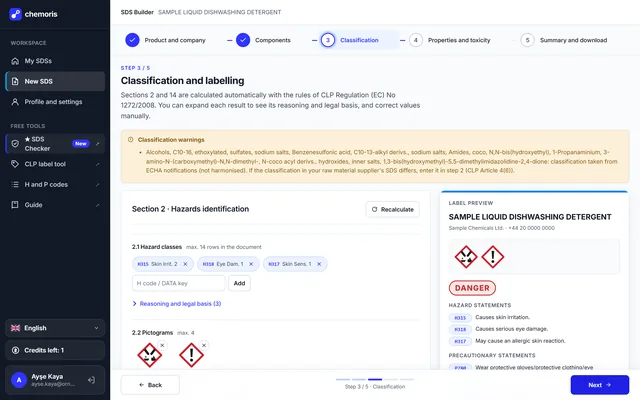
| 2. Hazards identification | Classification, label elements (pictograms, signal word, H and P statements), other hazards | CLP/SEA classification of the mixture |
| 3. Composition / information on ingredients | Identity of hazardous components (CAS, EC), concentration range, their classification | Formulation + C&L data of the components (e.g. the ECHA C&L Inventory) |
| 4. First-aid measures | First aid by route of exposure, symptoms | Standard phrases linked to the classification |
| 5. Firefighting measures | Suitable extinguishing media, combustion products, advice for firefighters | Physical hazards + product information |
| 6. Accidental release measures | Personal precautions, environmental precautions, clean-up methods | Standard phrases linked to the classification |
| 7. Handling and storage | Safe handling, storage conditions, incompatible materials | Product information + classification |
| 8. Exposure controls / personal protection | Occupational exposure limit values, PPE, engineering controls | Component limit values + classification |
| 9. Physical and chemical properties | Appearance, pH, flash point, density, solubility, etc. | The product's own measurements (laboratory) |
| 10. Stability and reactivity | Reactivity, stability, conditions and materials to avoid | Product information + component data |
| 11. Toxicological information | Acute toxicity, irritation, sensitisation, CMR, STOT, etc. | Registration dossier data of the components (e.g. ECHA REACH dossier summaries) |
| 12. Ecological information | Aquatic toxicity, persistence, bioaccumulation, PBT/vPvB | Registration dossier data of the components |
| 13. Disposal considerations | Waste treatment methods, packaging disposal | Standard phrases + waste legislation |
| 14. Transport information | UN number, proper shipping name, class, packing group, environmental hazards | ADR mapping from the classification |
| 15. Regulatory information | Product-specific legislation (KKDİK, SEA, restrictions), chemical safety assessment | List of legislation |
| 16. Other information | Revision changes, abbreviations, sources, full text of the H statements in Sections 2 and 3, preparer | The preparing KDU |
Consistency between sections: the most overlooked part
Most errors in a GBF do not come from a single section but from sections that do not match each other:
- Section 2 ↔ 3: if a "Skin Corr. 1B" component is at 10% in Section 3 but the mixture appears only as "irritant" in Section 2, the summation calculation has not been done. We explain the calculation with an example in Mixture classification under CLP.
- Section 2 ↔ 14: if the mixture is "Aquatic Chronic 1" (H410), the environmentally hazardous substance mark and a suitable UN number must be considered in Section 14.
- Section 2 ↔ 4–8: if H314 (corrosive) applies, the first-aid, PPE and storage measures must be written accordingly; generic text is not enough.
- Section 16: the full text of every H code in Sections 2 and 3 must appear here.
5 common mistakes
- Translating the supplier's GBF (often in a foreign language) and changing the product name: if the mixture is different, the classification is different too.
- Leaving subsections empty, or writing "no data" without stating the reason.
- Not marking the sections changed in a revision and not updating the version information on the first page.
- Referring to regulations that no longer apply (after 31.12.2023 a GBF is prepared only according to KKDİK Annex 2).
- Using phrases such as "harmless" or "environmentally friendly" that Annex 2 explicitly prohibits.
A printable tick-off version of this check for all 16 sections: SDS checklist (16 sections).
Sources
- KKDİK Regulation Annex 2, "Requirements for the Compilation of Safety Data Sheets" (Parts A and B).
- SEA Regulation (Official Gazette No. 28848 of 11/12/2013), CLP Regulation (EC) No 1272/2008.
- Ministry of Environment, Urbanisation and Climate Change of the Republic of Türkiye — Chemicals Helpdesk.
Codes in this article
Related codes
H and P statements related to this topic; each is explained in the glossary with its full wording, thresholds and label use.
- H304 May be fatal if swallowed and enters airways
- H318 Causes serious eye damage
- H336 May cause drowsiness or dizziness
- H360D May damage the unborn child
- H373 May cause damage to organs <or state all…
- P302 IF ON SKIN:
- P302+P352 IF ON SKIN: Wash with plenty of water/…
- P304+P340 IF INHALED: Remove person to fresh air and…
- P306 IF ON CLOTHING:
- P308+P313 IF exposed or concerned: Get medical…
- P320 Specific treatment is urgent (see … on this…
- P334 Immerse in cool water [or wrap in wet…
- P341
- P361+P364 Take off immediately all contaminated…
- P370+P380
- P377 Leaking gas fire: Do not extinguish, unless…
- P411+P235
Related articles
- SDS
How to check a safety data sheet: SDS review checklist in 12 steps
SDS check in three layers: format, consistency between sections, content. A 12-step REACH Annex II review and what to do when a supplier's SDS has errors.
- SDS
SDS consistency check: sections 2, 3, 9 and 14
Do SDS sections 2 and 3 disagree? Section pairs to check for classification, label elements, flash point, ADR transport, limit values and SVHC, with a matrix.
- SDS
How to choose SDS software: 8 criteria to check
How do you choose software to prepare a Turkish SDS? Data source, classification reasoning, regulatory format, Word output, revision and pricing model: an 8-point checklist and the KDU's responsibility.
Already have an SDS? Check it free
Upload the document you prepared or received from a supplier to the SDS checker and see inconsistencies and regulatory errors in seconds. Free, fair use.
 Prepare your SDS