
Contents
In short: In Türkiye the safety data sheet is called GBF (Güvenlik Bilgi Formu, the Turkish SDS). It is the 16-section document that explains how a hazardous chemical is to be used, stored, transported and disposed of safely. In English it is the SDS (Safety Data Sheet), formerly MSDS; all three names refer to the same document. In Türkiye it is prepared according to Annex 2 of the KKDİK Regulation (the Turkish REACH) and is given to the recipient free of charge by the supplier.
What is a GBF for?
The GBF is the official document through which the company passing a chemical to the next link in the supply chain informs the person who will use the product about its hazards and the precautions to take. The label gives a short warning; the GBF holds the detail: first aid, fire fighting, what to do after a spill, personal protective equipment, occupational exposure limits, physical and chemical properties, toxicological and ecotoxicological data, and the transport class.
Different people read the document, and each of them looks at different sections:
- Occupational safety specialist: Sections 2, 7 and 8 for risk assessment and the choice of personal protective equipment.
- Warehouse and logistics: Sections 7 and 10 for storage incompatibilities, Section 14 for transport.
- Emergency and medical staff: Section 4 (first aid), 5 (fire fighting) and 11 (toxicology).
- Environmental officer: Section 12 (ecological information) and 13 (disposal).
Are GBF, MSDS and SDS the same thing?
Yes. MSDS (Material Safety Data Sheet) is the name of the older format, in which the number of sections was not fixed. With the Globally Harmonized System (GHS) the document got a standard 16-section structure and was renamed SDS. The Turkish equivalent is Güvenlik Bilgi Formu (GBF). "MSDS" is still widely used in the market, but the document that applies today is the 16-section GBF.
The GBF is also confused with the technical data sheet (TDS). A TDS describes the product's performance, directions for use and technical properties; it is a marketing/application document with no legal structure. The GBF is a safety document whose content is set by regulation.
Who prepares it, and who asks for it?
Providing the GBF to the recipient is the supplier's obligation: the manufacturer, importer, distributor, or a downstream user that passes the product to the next link. Since 1 January 2024 the form may be prepared in Türkiye only according to KKDİK Annex 2 and only by a certified KDU (Kimyasal Değerlendirme Uzmanı, certified chemical assessment expert). For details see GBF under KKDİK: who prepares it, who is responsible?
The main cases in which a GBF must be provided:
- the substance or mixture is classified as hazardous under the SEA Regulation (the Turkish CLP),
- the substance is PBT or vPvB,
- the substance is on the candidate list prepared for substances subject to authorisation.
For some mixtures that are not classified as hazardous, a GBF must also be provided on the recipient's request if they contain certain hazardous components above a threshold. The form is provided free of charge, on paper or electronically, and in Turkish (KKDİK Article 27/5 and 27/8); in practice it is sent with the first delivery at the latest.
In practice, the GBF is most often requested by the purchasing and occupational health and safety departments of industrial customers, by the provincial directorates during inspections, by transport companies, and in tenders.
The 16 sections of a GBF
| Section | Title | Section | Title |
|---|---|---|---|
| 1 | Identification of the substance/mixture and of the company | 9 | Physical and chemical properties |
| 2 | Hazards identification | 10 | Stability and reactivity |
| 3 | Composition/information on ingredients | 11 | Toxicological information |
| 4 | First-aid measures | 12 | Ecological information |
| 5 | Firefighting measures | 13 | Disposal considerations |
| 6 | Accidental release measures | 14 | Transport information |
| 7 | Handling and storage | 15 | Regulatory information |
| 8 | Exposure controls/personal protection | 16 | Other information |
What goes into each section and where the data comes from is explained in How to prepare a GBF: the 16 sections one by one.
How the GBF relates to the label
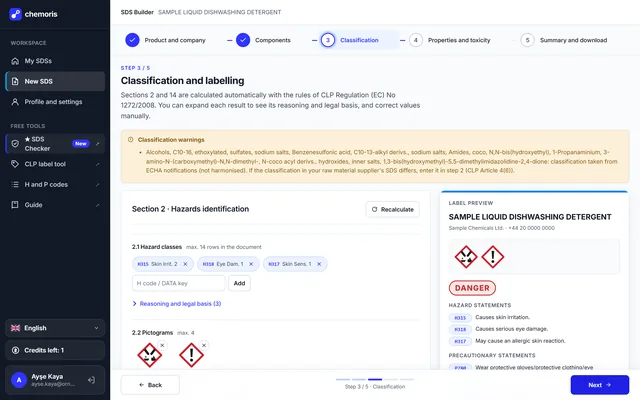
The information on the label comes from Section 2 of the GBF: pictograms, signal word, hazard (H) and precautionary (P) statements. The two must be consistent; writing "Danger" in the GBF and "Warning" on the label is one of the first errors spotted in an inspection. The mandatory label elements are covered in What must a chemical label contain?, and the meaning of the codes in the H and P code dictionary. To see the label elements for a list of H codes you can use the free CLP label tool.
Frequently asked questions
Does a GBF have a validity period?
The regulation sets no fixed period. The GBF is updated when new information affecting risk management becomes available, when an authorisation is granted or refused, or when a restriction is imposed. The updated form is sent to everyone who received the product in the previous 12 months.
Is the foreign supplier's English SDS enough?
No. For a product placed on the market in Türkiye, the GBF must be in Turkish, follow the KKDİK Annex 2 structure and be prepared by a certified chemical assessment expert (KDU). The English SDS is the most important data source for the Turkish form to be prepared.
Is a GBF needed for a product sold to consumers?
For hazardous products sold to the general public, providing a GBF to the consumer is not mandatory if the information needed for safe use is given on the label and packaging; however, it is provided if a downstream user or distributor requests it. For professional recipients in the supply chain a GBF is required in all cases.
Can I prepare the GBF myself?
Since 1 January 2024 only a certified chemical assessment expert (KDU) may prepare a GBF. If your company has no KDU, you can work with a consultancy. Chemoris is a preparation tool that speeds up the KDU's data collection and classification work; it does not replace the KDU's approval.
Sources
- KKDİK Regulation (23/06/2017, Official Gazette No. 30105), Article 27 and Annex 2.
- SEA Regulation (11/12/2013, Official Gazette No. 28848).
- REACH Regulation (EC) No 1907/2006, Article 31 and Annex II (the EU counterpart of KKDİK).
- UN GHS (Globally Harmonized System), Annex 4: guidance on the preparation of SDSs.
Related codes
H and P statements related to this topic; each is explained in the glossary with its full wording, thresholds and label use.
- H310 Fatal in contact with skin
- H319 Causes serious eye irritation
- H340 May cause genetic defects <state route of…
- H360F May damage fertility
- P301+P330+P331 IF SWALLOWED: Rinse mouth. Do NOT induce…
- P302+P350
- P304 IF INHALED:
- P305+P351+P338 IF IN EYES: Rinse cautiously with water for…
- P307+P311
- P312 Call a POISON CENTRE/doctor/… if you feel…
- P332 If skin irritation occurs:
- P337 If eye irritation persists:
- P352 Wash with plenty of water/…
- P370 In case of fire:
- P373 DO NOT fight fire when fire reaches…
- P391 Collect spillage
Related articles
- SDS
How to check a safety data sheet: SDS review checklist in 12 steps
SDS check in three layers: format, consistency between sections, content. A 12-step REACH Annex II review and what to do when a supplier's SDS has errors.
- SDS
SDS consistency check: sections 2, 3, 9 and 14
Do SDS sections 2 and 3 disagree? Section pairs to check for classification, label elements, flash point, ADR transport, limit values and SVHC, with a matrix.
- SDS
How to choose SDS software: 8 criteria to check
How do you choose software to prepare a Turkish SDS? Data source, classification reasoning, regulatory format, Word output, revision and pricing model: an 8-point checklist and the KDU's responsibility.
Already have an SDS? Check it free
Upload the document you prepared or received from a supplier to the SDS checker and see inconsistencies and regulatory errors in seconds. Free, fair use.
 Prepare your SDS