
Contents
In short: when choosing SDS software, the only question should not be "how fast do I get the form?" Since 1 January 2024 a Turkish SDS (GBF) can only be prepared by a Chemical Assessment Expert (KDU); software speeds up that expert's work, it does not take over the responsibility. The 8 criteria below let you narrow down in a few minutes which program fits your work.
Why is choosing software a decision of its own?
A Turkish SDS is a document made up of component data, CLP classification, H/P statements, pictograms, transport information and 16 sections of text, and it is prepared again for every product and every revision. Programs behave very differently depending on which part of this work they take on, in what format they deliver the output and how well you can check the result. A wrong choice means correcting the form manually afterwards or starting over.
8 criteria to check
- Data source. Where does the substance data come from, and can you see it? Data from public sources such as ECHA CHEM does not give the same confidence as a database of unclear origin.
- Reasoning behind the classification. Does the program give only the result, or does it also show which component and which CLP article a class came from? A result without reasoning makes the expert's check harder.
- Mixture calculation. Does it calculate the mixture class from component percentages (summation, thresholds, ATE formula) as rules? See mixture classification under CLP.
- Regulatory format. Selling to Türkiye requires the KKDİK (Turkish REACH) Annex 2 format; exporting to the EU requires the REACH Annex II format. Which one does the program produce, and in which language?
- Output format. An editable document (Word) or a PDF that cannot be changed? You will need to adapt the text to customer requests.
- Ease of revision. When the recipe changes, do you rewrite the form from scratch, or does everything recalculate when you open the saved form and change the component? See when must a Turkish SDS be updated?
- The expert's control. Are the fields editable, and are missing or warning-worthy items listed? The KDU must be able to do the final check.
- Pricing model. Per product, subscription or credits? The total cost varies a lot with the number of products you have; also check whether there is a trial.
Does the software replace the KDU?
No. Under KKDİK Article 27, the GBF has been prepared by a KDU since 2024 and the responsibility stays with the supplier. A program can take over repetitive work such as collecting component data, calculating the classification and generating the document; the final check and signature of the prepared form belong to the expert. Details: what is a KDU? and GBF under KKDİK.
How does Chemoris answer these criteria?
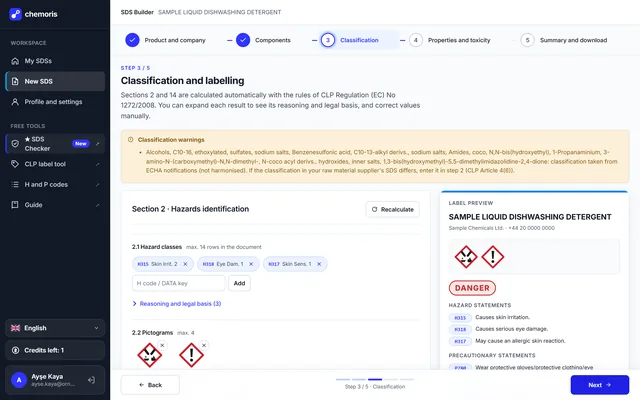
- It pulls substance data from ECHA CHEM, calculates the classification with CLP rules and shows, next to each hazard class, which component and which CLP article it came from.
- It delivers the 16-section GBF as an editable Word document: in the Turkish KKDİK format or in the REACH Annex II format in the 23 official EU languages.
- It keeps your saved GBFs in one panel; when you change a component and reopen the form, the classification and label are recalculated.
- All fields are editable; missing fields are listed as warnings. Chemoris does not replace an expert assessment.
- New accounts get 1 free GBF credit, no credit card needed; the wizard and preview are free. Prices: credit packs.
To see how the sections of the form are built, read how to prepare a Turkish SDS, or create a free account.
Frequently asked questions
Do I still need a KDU if I use SDS software?
Yes. Since 1 January 2024 the person who prepares the GBF must be a KDU; the program is a tool that speeds up that person's work. The supplier is responsible for the accuracy of the form.
Does the program keep the SDS it produced up to date by itself?
No. When the regulation or the composition changes, the form has to be reviewed and revised; the program makes it easier to open the saved form and recalculate. For update conditions see the related guide.
Which output format is better: Word or PDF?
You may need to send your customer a PDF; however, during production an editable document (Word) is more practical for revision and adaptation. Converting Word to PDF is easy, the reverse is not.
Sources
- KKDİK Regulation (23/06/2017, Official Gazette 30105), Article 27 and Annex 2 (text on mevzuat.gov.tr).
- CLP Regulation (EU) 1272/2008, Annex I (classification of mixtures).
- REACH Regulation (EU) 1907/2006, Annex II (safety data sheet).
Related articles
- SDS
How to check a safety data sheet: SDS review checklist in 12 steps
SDS check in three layers: format, consistency between sections, content. A 12-step REACH Annex II review and what to do when a supplier's SDS has errors.
- SDS
SDS consistency check: sections 2, 3, 9 and 14
Do SDS sections 2 and 3 disagree? Section pairs to check for classification, label elements, flash point, ADR transport, limit values and SVHC, with a matrix.
- SDS
Free SDS software: what is actually free?
The label tool, H/P code glossary and guides are free; the GBF wizard and preview come with a free account. A free GBF credit for new accounts, and which step uses a credit for the Word download.
 Prepare your SDS