
Contents
In short: a GBF (Güvenlik Bilgi Formu, the Turkish safety data sheet) has no "period of validity" written in the regulation. The supplier updates the GBF without delay in three cases: when new information that may affect risk management or new information on hazards becomes available, when an authorisation is granted or refused, and when a restriction is imposed (KKDİK Article 27/9; KKDİK is often called "Turkish REACH"). The updated form is sent free of charge to everyone who received the product within the previous 12 months (Article 27/10).
What does the regulation say?
Under paragraph 9 of KKDİK Article 27, suppliers update their safety data sheets without delay in the following cases:
- when information that may affect the risk management measures, or new information on hazards, becomes available,
- when an authorisation has been granted or refused,
- when a restriction has been imposed.
Paragraph 10 adds two more points: the updated form is provided free of charge, on paper or electronically, to all recipients to whom the product was supplied within the preceding 12 months, and every update made after registration includes the substance's registration number.
There is no rule such as "renewed every year" or "renewed every 3 years". Date and version are mandatory, however: the form is dated (Article 27/6), and what changed in the revision is stated in Section 16 (Annex 2).
What triggers an update in practice?
"New information" is a broad term. These are the triggers chemical manufacturers meet most often:
| Change | GBF sections affected |
|---|---|
| Formulation change (component added, proportion changed) | 2, 3; usually 8, 11, 12, 14 and the label |
| The harmonised classification of a component changed (CLP adaptations, ATPs) | 2, 3, 11, 12, 15; the classification of the mixture is recalculated |
| A new GBF arrived from the supplier | All sections that depend on the raw material, especially 3, 8, 11, 12 |
| An occupational exposure limit value was added or changed | 8 (and 3 if the component now has a limit value) |
| The substance was registered under KKDİK | 1 and 3 (registration number), annex if there is an exposure scenario |
| The substance entered the candidate list (SVHC) or was restricted | 2, 3, 15 |
| New edition of the transport rules (ADR is published every two years) | 14 |
| Company name, address or emergency telephone number changed | 1 |
The practical consequence: even the GBF of a product whose formulation never changes can become outdated, because the classification of components and the legislation change. That is why many companies review their GBFs at regular intervals (e.g. once a year), even though there is no legal requirement to do so.
KKDİK registration deadlines and GBF updates
Under KKDİK, the registration deadlines for substances are staggered by tonnage and hazard; the first is 31/12/2026 (1000 tonnes or more per year, and certain highly hazardous substances). For registered substances, the information in the GBF must be consistent with the registration dossier, and updates must include the registration number. So as registrations are completed in the coming period, the GBFs of products containing these substances will also be updated. The table of deadlines is in GBF under KKDİK: who prepares it, who is responsible?
How should an update be done?
- Version and date: the new version number and revision date on the first page; the list of changed sections in Section 16.
- Do not forget the label: if Section 2 changed (pictogram, signal word, H/P), the packaging label changes too; plan the transition for stock with old labels.
- Distribution record: without a list of customers who received the product in the last 12 months, the Article 27/10 obligation cannot be met. Record which version went to which customer and when.
- Preparer: an update, like the first version, is done by a Kimyasal Değerlendirme Uzmanı (KDU), a certified chemical assessment expert.
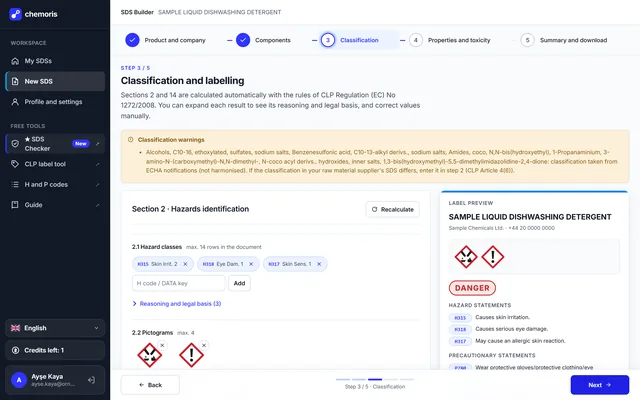
In Chemoris, when you reopen a GBF and change a component, the classification, label and transport information are recalculated from scratch; you see what changed in Sections 2 and 14. You can try it with a free account.
Frequently asked questions
Does a GBF have an expiry date?
No. The regulation sets no fixed period of validity; the form is updated when there is a trigger such as new information, an authorisation or a restriction. An older form is valid as long as its content is still correct.
Do I have to resend it to customers for a small correction (a typo)?
Paragraph 27/10 requires the "updated" form to be provided. For corrections that do not change the risk information, companies usually wait for the next substantive update; however, every change affecting Section 2, 3, 8 or 14 should be sent.
My supplier updated its GBF; do I need to update mine too?
Yes, if the supplier's change affects the hazard information, the classification or the recommended measures: this falls under "new information" in Article 27/9. First check whether the classification of the mixture changes.
Sources
- KKDİK Regulation (23/06/2017, Official Gazette No. 30105), Article 27 paragraphs 6, 9, 10 and Annex 2 (text on mevzuat.gov.tr).
- Regulation amending the KKDİK Regulation (23/12/2023, Official Gazette No. 32408).
- REACH Regulation (EC) No 1907/2006, Article 31/9 (EU counterpart).
Related codes
H and P statements related to this topic; each is explained in the glossary with its full wording, thresholds and label use.
Related articles
- Regulation
SDS regulatory calendar 2026-2028: dates that change your safety data sheet
EU dates for SDS in 2026-2028: new CLP hazard classes (ED, PBT, PMT), Annex VI updates, REACH Annex II, UFI and the CLP revision, with legal sources.
- Regulation
Turkish SDS: consultant, software or an in-house KDU?
Three ways to prepare a GBF: a KDU on staff, an external KDU or consultancy, or a KDU plus software. A comparison table, when each makes sense and who stays responsible.
- Regulation
SDS requirements compared: EU REACH, UK REACH and US OSHA HazCom
EU REACH Annex II (2020/878), UK REACH and OSHA HazCom 1910.1200 compared: who supplies the SDS, language, format and update deadlines.
 Prepare your SDS