
Hazard statement · Health hazards
What does H331 mean?
Toxic if inhaled.
- Hazard class
- Acute toxicity (inhal.), Hazard Category 3 (Acute Tox. 3)
- Pictogram
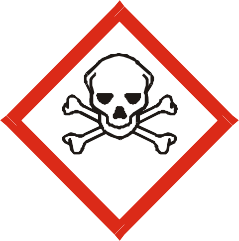 GHS06Skull and crossbones
- Signal word
- Danger
Categories and label elements
| CLP abbreviation | Pictogram | Signal word |
|---|---|---|
| Acute Tox. 3 | GHS06Skull and crossbones | Danger |
Related precautionary statements (P codes)
The precautionary statements that CLP Annex IV assigns to this class. Not all of them go on the label: under CLP Article 28(3), no more than six precautionary statements appear on the label unless the nature and severity of the hazard require more; the selection depends on the product and its users.
Build a label with this class. The free label tool works out the pictogram, the signal word and the P statements for the label from the classes you choose.
When does a mixture need H331?
Whether a mixture needs H331 is calculated from the classes and concentrations of its components. The values in the rule file for this code are:
- A component of this class is taken into account in a mixture only at a concentration of ≥ 0.1 %. (CLP Annex I Table 1.1)
- The category of the mixture is calculated from the ATE values of the components (route: inhalation) with the additivity formula 100/ATEmix = Σ(Ci/ATEi).
For a step-by-step worked example see classifying a mixture under CLP.
Where is H331 written in the SDS?
H331 is tracked in three places of the SDS: the classification line in Section 2.1 ("Acute Tox. 3"), the label elements in Section 2.2 and the component list in Section 3. Section 16 repeats the explanation of the code. In addition, it is justified in Section 11 (toxicological information) under the relevant effect heading.
How does H331 appear on the label?
The label elements for H331 are: pictogram GHS06 (skull and crossbones); it is written with the signal word "Danger". In the Chemoris template Section 2.2 carries at most 8 H statements; if the limit is exceeded the least severe ones are dropped and a warning is shown. For the bottom of the label, 8 P statements are candidates for this class in CLP Annex IV; under CLP Article 28 at most 6 of them are selected.
Where does it appear in the safety data sheet?
- Section 2.1: classification; the class abbreviation and H331 are given together.
- Section 2.2: label elements; H331 with its full text, pictogram and signal word.
- Section 3: composition table; in the row of every component that has this class.
- Section 16: the full text of the H statements cited as codes in earlier sections.
Class criteria and thresholds for H331
The values below come from the Chemoris rule file (CLP Annex I). They show the condition under which H331 arises in a mixture. For physical hazards and other classes that depend on test data, the result comes from the mixture's own measurement, not from component percentages.
| Class | Criterion | Limit / formula | Source |
|---|---|---|---|
| Acute Tox. 3 | Acute toxicity range (inhalation (gas) route) | 500 < ATE ≤ 2500 ppmV | CLP Annex I Table 3.1.1 / 3.1.2 (gazlar) |
| Acute Tox. 3 | Converted value used when a component's ATE is unknown (inhalation (gas)) | 700 ppmV | CLP Annex I Table 3.1.1 / 3.1.2 (gazlar) |
| Acute Tox. 3 | Acute toxicity range (inhalation (vapour) route) | 2 < ATE ≤ 10 mg/L | CLP Annex I Table 3.1.1 / 3.1.2 (buharlar) |
| Acute Tox. 3 | Converted value used when a component's ATE is unknown (inhalation (vapour)) | 3 mg/L | CLP Annex I Table 3.1.1 / 3.1.2 (buharlar) |
| Acute Tox. 3 | Acute toxicity range (inhalation (dust/mist) route) | 0.5 < ATE ≤ 1 mg/L | CLP Annex I Table 3.1.1 / 3.1.2 (dust/mist) |
| Acute Tox. 3 | Converted value used when a component's ATE is unknown (inhalation (dust/mist)) | 0.5 mg/L | CLP Annex I Table 3.1.1 / 3.1.2 (dust/mist) |
| Acute Tox. 3 | Minimum concentration for a component to be considered | ≥ 0.1 % | CLP Annex I Table 1.1 |
H331 compared with H330 and H332
The table below puts H331 next to its closest neighbouring statements; the values are read from the rule data.
| Hazard statement | H331 | H330 | H332 |
|---|---|---|---|
| Class abbreviation | Acute Tox. 3 | Acute Tox. 1 / Acute Tox. 2 | Acute Tox. 4 |
| Pictogram | GHS06 | GHS06 | GHS07 |
| Signal word | Danger | Danger | Warning |
| Precautionary statements assigned | 8 | 9 | 4 |
| Concentration cut-off in a mixture | 0.1 % | 0.1 % | 1 % |
H331 and H330 carry the same signal word (Danger). Both are shown with the same pictogram (GHS06). The signal word differs: Danger for H331, Warning for H332. The pictogram differs: GHS06 for H331, GHS07 for H332.
In which SDS sections does H331 appear?
H331 does not stay only in the label section of an SDS; the class itself and the precautionary statements assigned to it shape the content of other sections too. The counts are calculated from the P statements that Annex IV assigns to this class.
| SDS section | Relation to this code |
|---|---|
| 2.1 Classification | Written with the abbreviation Acute Tox. 3 and the code H331. |
| 2.2 Label elements | H331 appears with its full text, GHS06 (skull and crossbones) and “Danger”. |
| 3 Composition | The class and code show in the row of every component that carries this class. |
| 11 Toxicological information | The health effect is justified here under the relevant endpoint heading. |
| 4 First aid | Of the 8 assigned P statements, 3 belong to the subject of this section: P304+P340, P311, P321. |
| 7 Handling and storage | Of the 8 assigned P statements, 4 belong to the subject of this section: P261, P271, P403+P233. |
| 13 Disposal | Of the 8 assigned P statements, 1 belong to the subject of this section: P501. |
| 14 Transport | ADR mapping: Class 6.1, packing group II; ADR 2.2.61.1.7. |
| 16 Other information | The full text of the H statements cited by code is collected here. |
Statements that appear on the label together with H331
H331 is never printed alone on a label; it sits next to the pictogram and the signal word. The Chemoris selection method (response, prevention, storage, disposal in that order; core statements first) gives these first 5 candidates for this class:
| Rank | P code | Type | Priority | Text |
|---|---|---|---|---|
| 1 | P304+P340 | response | core | IF INHALED: Remove person to fresh air and keep comfortable for breathing. |
| 2 | P311 | response | core | Call a POISON CENTER/doctor/… |
| 3 | P261 | prevention | core | Avoid breathing dust/fume/gas/mist/vapours/spray. |
| 4 | P271 | prevention | core | Use only outdoors or in a well-ventilated area. |
| 5 | P405 | storage | core | Store locked up. |
The GHS06 pictogram and “Danger” are printed together. This ranking applies because a label usually carries at most 6 statements; when a combined statement is selected, its parts are not printed again.
Official EU wording of H331 in other languages
When a product is exported to the EU, the SDS and label are expected in the official language of the Member State where it is placed on the market (REACH Article 31(5)). The table gives the official wording of H331 from the CLP Annex III/IV language versions published in the Official Journal of the European Union. Source: EUR-Lex CELEX 02008R1272-20260701.
| Language | Official wording | Class title | Signal word |
|---|---|---|---|
| German | Giftig bei Einatmen. | Akute Toxizität (inhalativ), Gefahrenkategorie 3 | Gefahr |
| French | Toxique par inhalation. | Toxicité aiguë (par inhalation), catégorie de danger 3 | Danger |
| Spanish | Tóxico en caso de inhalación. | Toxicidad aguda (por inhalación), categoría 3 | Peligro |
| Italian | Tossico se inalato. | Tossicità acuta in caso di inalazione, categoria di pericolo 3 | Pericolo |
| Polish | Działa toksycznie w następstwie wdychania. | Toksyczność ostra (po narażeniu inhalacyjnym), kategoria zagrożenia 3 | Niebezpieczeństwo |
| Dutch | Giftig bij inademing. | Acute toxiciteit bij inademing, gevarencategorie 3 | Gevaar |
| Portuguese | Tóxico por inalação. | Toxicidade aguda (via inalatória), categoria de perigo 3 | Perigo |
| Romanian | Toxic în caz de inhalare. | Toxicitate acută (inhalare), categoria de pericol 3 | Pericol |
Common mistakes with H331
- Mixing up exposure routes: H331 concerns only the inhalation (vapour) route; ATE is calculated separately for each route (CLP Annex I 3.1.3.6.1 (formula), Table 3.1.1 (category ranges), Table 3.1.2 (converted ATE)).
- Pouring every P candidate onto the label: there are 8 candidates, but CLP Article 28(3) limits a label to 6 precautionary statements (up to 8 when needed).
- Writing unlimited H statements for a multi-class product: in the Chemoris template, Section 2.2 holds at most 8 H statements.
Next steps
To read a statement like H331 correctly on a label and in an SDS, see the guide How to read H and P codes; to pick the class and prepare the label automatically, use the free label tool.
Related hazard statements
Other H statements in the same hazard family as H331 (Acute Tox.). The difference between categories mostly comes from the degree of severity.
Frequently asked questions
Which pictogram and signal word go with H331 on a label?
For H331 the pictogram is GHS06 (skull and crossbones); it is written with the signal word "Danger".
How many P statements does H331 need?
CLP Annex IV assigns 8 precautionary statements to the class of H331, but under CLP Article 28(3) a label usually carries at most 6 of them; the selection depends on the product and its user.
When does a mixture need H331?
A component of this class is taken into account in a mixture only at a concentration of ≥ 0.1 %. The category of the mixture is calculated from the ATE values of the components (route: inhalation) with the additivity formula 100/ATEmix = Σ(Ci/ATEi). Details are in the section "When does a mixture need H331?" above.
In which SDS sections does H331 appear?
H331 appears in Sections 2.1 (classification), 2.2 (label), 3 (composition) and 16, and also in 11, 4, 7, 13 and 14.
What is the difference between H331 and H330?
H331 carries Danger and GHS06; H330 carries Danger and GHS06.
Which numerical limits apply to H331 in a mixture?
Acute Tox. 3: 500 < ATE ≤ 2500 ppmV; Acute Tox. 3: 700 ppmV; Acute Tox. 3: 2 < ATE ≤ 10 mg/L.
Source: Regulation (EC) No 1272/2008 (CLP) Annexes I and III; Turkish SEA Regulation (Official Gazette 28848). The statement is the official English text of CLP Annex III. Pictogram and signal word: CLP Annex I Table 3.1.3. Updated: 6 November 2026.
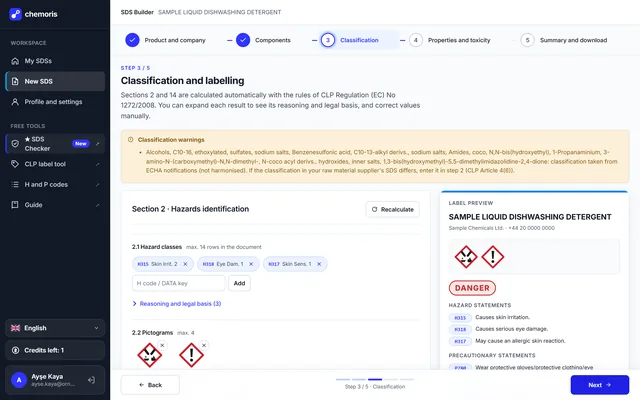 Prepare your SDS