
Contents
- Why do inconsistencies happen?
- Section 2 ↔ section 3: classification and composition
- Section 2.1 ↔ 2.2: classification and label elements
- Section 2 ↔ 9 ↔ 14: physical data and transport
- Section 3 ↔ 8 and 15: limit values and lists
- Section 2 ↔ 11 and 12: supporting information
- Summary: consistency matrix
- Automating the consistency check
- Frequently asked questions
- Sources
In short: the sections of a safety data sheet (SDS) are not independent. The classification in section 2 is derived from the ingredients in section 3; the label elements, the transport information and the regulatory section follow from that classification. When one section changes and the others are not updated, the sheet contradicts itself. This guide lists the section pairs to check and what to look for in each.
Why do inconsistencies happen?
The most common cause is a revision made in one section only: the share of an ingredient changes, section 3 is updated, but section 2 keeps the old classification. The second cause is assembling parts from different sources: transport information copied from another product, physical data taken from a raw material sheet. The third is a valid exception that is not explained: a classification based on test data or a bridging principle may differ from the calculation, and that is legitimate, but the reader should be able to see why from the sheet.
Section 2 ↔ section 3: classification and composition
Without test data, a mixture is classified from the classification and share of its ingredients using the rules of CLP Annex I (summation methods, generic cut-off values, specific concentration limits, M-factors). Questions to ask:
- Is a classified ingredient present at a high share in section 3 while that hazard family is missing from section 2?
- Within the same family, is the category in section 2 milder than the ingredients suggest (for example irritation where corrosion is expected)?
- If an ingredient has a harmonised classification (CLP Annex VI), does its row in section 3 reflect it?
- Do the lower bounds of the concentration ranges add up to more than 100?
A difference between the calculation and the expected result is not an error in itself, but its reason (for example a test on the mixture) should be visible in section 11 or 9. Details: CLP mixture classification and SDS section 3.
Section 2.1 ↔ 2.2: classification and label elements
The label elements in 2.2 follow from the classification in 2.1. The signal word is chosen by the most severe category (CLP Article 20); the precedence rules apply to pictograms (CLP Article 26); every hazard statement in 2.1 has its counterpart in 2.2 (CLP Article 21). Different sets of H codes in 2.1 and 2.2 are a typical sign that one of the two subsections was forgotten in a revision. The product name must match the label and 1.1 (CLP Article 18).
Section 2 ↔ 9 ↔ 14: physical data and transport
The flammable liquid classification rests on the flash point and the initial boiling point: flash point below 23 °C and initial boiling point at or below 35 °C is Category 1 (H224), flash point below 23 °C and initial boiling point above 35 °C is Category 2 (H225), flash point from 23 to 60 °C is Category 3 (H226). If section 2 has this class but section 9 has no flash point, the basis of the classification is not visible in the sheet.
Transport classification is a separate system from CLP and does not map one to one, yet some links can be checked. If section 14 says "not dangerous goods" while section 2 shows a flammable liquid, corrosivity or aquatic Acute 1/Chronic 1-2, an explanation is needed; the same holds if the class in section 14 (for example 8) points to a hazard with no counterpart in section 2. Because ADR has exemptions, not every difference is an error, but every difference is a question. Details: SDS section 14 and ADR.
Section 3 ↔ 8 and 15: limit values and lists
- 8.1: if an ingredient in section 3 has an occupational exposure limit, that value should appear in 8.1. A sheet for a given country uses that country's limit values.
- 15.1: if a Candidate List substance (SVHC) is present at 0.1% or more, it is expected to be named in section 3 and in section 15.
Section 2 ↔ 11 and 12: supporting information
For every health hazard in section 2 there should be relevant information in section 11, and for every environmental hazard in section 12, or a statement of why data are not available. If ingredient data are given, the sheet should say clearly that they are not data on the mixture.
Summary: consistency matrix
| Section pair | Link to check | Basis |
|---|---|---|
| 1.1 ↔ label | Same product name | CLP Art. 18 |
| 2.1 ↔ 3 | Hazard families and categories expected from the ingredients | CLP Annex I |
| 2.1 ↔ 2.2 | Signal word, pictogram precedence, H codes | CLP Art. 20, 21, 26 |
| 2.1 ↔ 9 | Flash point behind the flammable class | CLP Annex I 2.6 |
| 2.1 ↔ 14 | Transport-relevant hazard vs section 14 | ADR Chapter 2.2 |
| 3 ↔ 8, 15 | Limit values, SVHC | REACH Annex II 8.1, 15.1 |
| 2.1 ↔ 11, 12 | Information or reason for every hazard | REACH Annex II 11, 12 |
Automating the consistency check
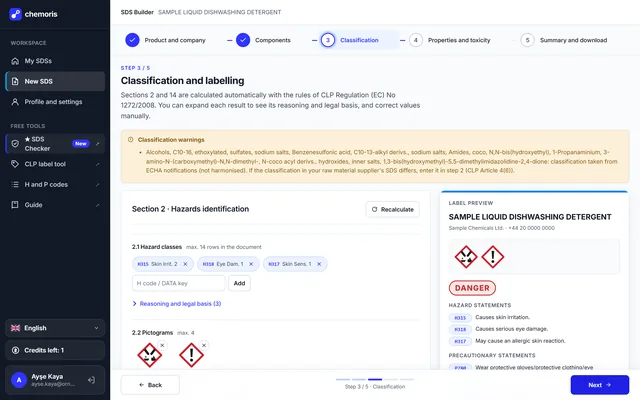
Most of these links can be written as rules, so software can scan them. The SDS checker for a section 2-3-14 consistency check recalculates the mixture classification from the ingredients it reads in section 3 of the uploaded SDS and compares it with sections 2.1, 2.2, 9, 14, 8 and 15. It reports each finding by section and type; it does not write the correct category, H code or UN number. It cannot see confidential ingredients, and it is not a substitute for expert assessment. To review every section manually, use the SDS checklist; for the order of steps, see how to check a safety data sheet.
Frequently asked questions
If section 2 and section 3 disagree, is the SDS definitely wrong?
Not definitely. A test on the mixture or a bridging principle can give a result different from the calculation. In that case the reason should be visible in the sheet; if it is not, ask the author about the difference.
The SDS has a flammable liquid class but section 14 says "not dangerous goods". Is that possible?
It is possible, because ADR has some exemptions (for example for certain viscous liquids), but the basis of the exemption should be stated. Without an explanation, treat it as an inconsistency.
Which sections need updating when the formulation changes?
At least section 3; if the classification changes, also section 2 and the label elements derived from it, sections 14 and 15, and as relevant 8, 9, 11 and 12. The change is noted in the revision note.
Sources
- Regulation (EC) No 1272/2008 (CLP), Articles 17-28, Annex I (2.6 flammable liquids), Annex VI.
- Regulation (EC) No 1907/2006 (REACH), Article 31 and Annex II (as amended by Regulation (EU) 2020/878).
- KKDİK Regulation (23/06/2017, Official Gazette No 30105), Article 27 and Annex 2.
- ADR 2025, Chapter 2.2 (2.2.3 Class 3, 2.2.8 Class 8, 2.2.9.1.10 environmentally hazardous substances).
Codes in this article
Related codes
H and P statements related to this topic; each is explained in the glossary with its full wording, thresholds and label use.
- H400 Very toxic to aquatic life
- H410 Very toxic to aquatic life with long lasting…
- H411 Toxic to aquatic life with long lasting…
- H413 May cause long lasting harmful effects to…
- P222 Do not allow contact with air
- P234 Keep only in original packaging
- P244 Keep valves and fittings free from oil and…
- P264 Wash … thoroughly after handling
- P282 Wear cold insulating gloves and either face…
- P309+P311
- P322
- P335+P334
- P342+P311 If experiencing respiratory symptoms: Call a…
- P362+P364 Take off contaminated clothing and wash it…
- P371 In case of major fire and large quantities:
- P380 Evacuate area
- P413 Store bulk masses greater than … kg/… lbs at…
Related articles
- SDS
How to check a safety data sheet: SDS review checklist in 12 steps
SDS check in three layers: format, consistency between sections, content. A 12-step REACH Annex II review and what to do when a supplier's SDS has errors.
- SDS
How to choose SDS software: 8 criteria to check
How do you choose software to prepare a Turkish SDS? Data source, classification reasoning, regulatory format, Word output, revision and pricing model: an 8-point checklist and the KDU's responsibility.
- SDS
Free SDS software: what is actually free?
The label tool, H/P code glossary and guides are free; the GBF wizard and preview come with a free account. A free GBF credit for new accounts, and which step uses a credit for the Word download.
 Prepare your SDS