
Hazard statement · Environmental hazards
What does H413 mean?
May cause long lasting harmful effects to aquatic life.
- Hazard class
- Hazardous to the aquatic environment — Chronic Hazard, Category 4 (Aquatic Chronic 4)
- Pictogram
- No pictogram
- Signal word
- No signal word
Categories and label elements
| CLP abbreviation | Pictogram | Signal word |
|---|---|---|
| Aquatic Chronic 4 | No pictogram | No signal word |
Related precautionary statements (P codes)
The precautionary statements that CLP Annex IV assigns to this class. Not all of them go on the label: under CLP Article 28(3), no more than six precautionary statements appear on the label unless the nature and severity of the hazard require more; the selection depends on the product and its users.
Build a label with this class. The free label tool works out the pictogram, the signal word and the P statements for the label from the classes you choose.
When does a mixture need H413?
For a pure substance H413 comes straight from the classification; for a mixture it is derived from component data. The calculation rules applied to this code are:
- A component of this class is taken into account in a mixture only at a concentration of ≥ 1 %. (CLP Annex I Table 1.1)
- Summation method: the weighted sum of the qualifying components must reach ≥ 25 % for the mixture to be classified Aquatic Chronic 4 (H413). (CLP Annex I Table 4.1.2; 4.1.3.5.5.4.5)
- If a component has a harmonised specific concentration limit (SCL) and meets it, the mixture takes the corresponding class directly.
For a step-by-step worked example see classifying a mixture under CLP.
Where is H413 written in the SDS?
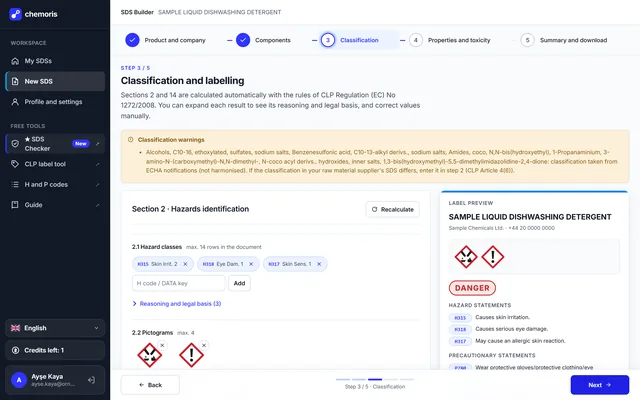
In the prepared SDS the class "Aquatic Chronic 4" is matched with the code in Section 2.1, the text of H413 is written in Section 2.2 next to the pictogram and signal word, and the class of the component shows up in Section 3. Section 16 collects the full text of the H statements cited by code. For H413, it is justified in Section 12 (ecological information) under the relevant effect heading.
How does H413 appear on the label?
When you see H413 on a label it is accompanied by no pictogram, and it needs no signal word. In the Chemoris template Section 2.2 carries at most 8 H statements; if the limit is exceeded the least severe ones are dropped and a warning is shown. For the bottom of the label, 2 P statements are candidates for this class in CLP Annex IV; under CLP Article 28 at most 6 of them are selected.
Where does it appear in the safety data sheet?
- Section 2.1: classification; the class abbreviation and H413 are given together.
- Section 2.2: label elements; H413 with its full text, pictogram and signal word.
- Section 3: composition table; in the row of every component that has this class.
- Section 16: the full text of the H statements cited as codes in earlier sections.
Class criteria and thresholds for H413
The values below come from the Chemoris rule file (CLP Annex I). They show the condition under which H413 arises in a mixture. For physical hazards and other classes that depend on test data, the result comes from the mixture's own measurement, not from component percentages.
| Class | Criterion | Limit / formula | Source |
|---|---|---|---|
| Aquatic Chronic 4 | Minimum concentration for a component to be considered | ≥ 1 % | CLP Annex I Table 1.1 |
| Aquatic Chronic 4 | Additive formula by which a mixture reaches this class | Σ(Aquatic Chronic 1/2/3/4) ≥ 25 % | CLP Annex I Table 4.1.2; 4.1.3.5.5.4.5 |
H413 compared with H412 and H411
The table below puts H413 next to its closest neighbouring statements; the values are read from the rule data.
| Hazard statement | H413 | H412 | H411 |
|---|---|---|---|
| Class abbreviation | Aquatic Chronic 4 | Aquatic Chronic 3 | Aquatic Chronic 2 |
| Pictogram | none | none | GHS09 |
| Signal word | — | — | — |
| Precautionary statements assigned | 2 | 2 | 3 |
| Concentration cut-off in a mixture | 1 % | 1 % | 1 % |
H413 and H412 carry the same signal word (—). Both are shown with the same pictogram (none). H413 and H411 carry the same signal word (—). The pictogram differs: none for H413, GHS09 for H411.
In which SDS sections does H413 appear?
H413 does not stay only in the label section of an SDS; the class itself and the precautionary statements assigned to it shape the content of other sections too. The counts are calculated from the P statements that Annex IV assigns to this class.
| SDS section | Relation to this code |
|---|---|
| 2.1 Classification | Written with the abbreviation Aquatic Chronic 4 and the code H413. |
| 2.2 Label elements | H413 appears with its full text, none and none. |
| 3 Composition | The class and code show in the row of every component that carries this class. |
| 12 Ecological information | The aquatic or environmental effect is justified here. |
| 7 Handling and storage | Of the 2 assigned P statements, 1 belong to the subject of this section: P273. |
| 13 Disposal | Of the 2 assigned P statements, 1 belong to the subject of this section: P501. |
| 16 Other information | The full text of the H statements cited by code is collected here. |
Statements that appear on the label together with H413
H413 is never printed alone on a label; it sits next to the pictogram and the signal word. The Chemoris selection method (response, prevention, storage, disposal in that order; core statements first) gives these first 2 candidates for this class:
| Rank | P code | Type | Priority | Text |
|---|---|---|---|---|
| 1 | P273 | prevention | core | Avoid release to the environment. |
| 2 | P501 | disposal | core | Dispose of contents/container to … |
The none pictogram and none are printed together. This ranking applies because a label usually carries at most 6 statements; when a combined statement is selected, its parts are not printed again.
Official EU wording of H413 in other languages
When a product is exported to the EU, the SDS and label are expected in the official language of the Member State where it is placed on the market (REACH Article 31(5)). The table gives the official wording of H413 from the CLP Annex III/IV language versions published in the Official Journal of the European Union. Source: EUR-Lex CELEX 02008R1272-20260701.
| Language | Official wording | Class title | Signal word |
|---|---|---|---|
| German | Kann für Wasserorganismen schädlich sein, mit langfristiger Wirkung. | Chronisch gewässergefährdend, Gefahrenkategorie 4 | — |
| French | Peut être nocif à long terme pour les organismes aquatiques. | Dangereux pour le milieu aquatique — Danger chronique, catégorie 4 | — |
| Spanish | Puede ser nocivo para los organismos acuáticos, con efectos nocivos duraderos. | Peligroso para el medio ambiente acuático — Peligro crónico, categoría 4 | — |
| Italian | Può essere nocivo per gli organismi acquatici con effetti di lunga durata. | Pericoloso per l'ambiente acquatico — Pericolo cronico, categoria 4 | — |
| Polish | Może powodować długotrwałe szkodliwe skutki dla organizmów wodnych. | Stwarzające zagrożenie dla środowiska wodnego – zagrożenie przewlekłę, kategoria 4 | — |
| Dutch | Kan langdurige schadelijke gevolgen voor in het water levende organismen hebben. | Chronisch gevaar voor het aquatisch milieu, gevarencategorie 4 | — |
| Portuguese | Pode provocar efeitos nocivos duradouros nos organismos aquáticos. | Perigoso para o ambiente aquático — Toxicidade crónica da categoria 4 | — |
| Romanian | Poate provoca efecte nocive pe termen lung asupra mediului acvatic. | Periculos pentru mediul acvatic – pericol cronic, categoria 4 | — |
Common mistakes with H413
- Writing unlimited H statements for a multi-class product: in the Chemoris template, Section 2.2 holds at most 8 H statements.
Next steps
To read a statement like H413 correctly on a label and in an SDS, see the guide How to read H and P codes; to pick the class and prepare the label automatically, use the free label tool.
Related hazard statements
Other H statements in the same hazard family as H413 (Aquatic Chronic). The difference between categories mostly comes from the degree of severity.
Frequently asked questions
Which pictogram and signal word go with H413 on a label?
For H413 the pictogram is none; it needs no signal word.
How many P statements does H413 need?
CLP Annex IV assigns 2 precautionary statements to the class of H413, but under CLP Article 28(3) a label usually carries at most 6 of them; the selection depends on the product and its user.
When does a mixture need H413?
A component of this class is taken into account in a mixture only at a concentration of ≥ 1 %. Summation method: the weighted sum of the qualifying components must reach ≥ 25 % for the mixture to be classified Aquatic Chronic 4 (H413). Details are in the section "When does a mixture need H413?" above.
In which SDS sections does H413 appear?
H413 appears in Sections 2.1 (classification), 2.2 (label), 3 (composition) and 16, and also in 12, 7 and 13.
What is the difference between H413 and H412?
H413 carries — and none; H412 carries — and none.
Which numerical limits apply to H413 in a mixture?
Aquatic Chronic 4: ≥ 1 %; Aquatic Chronic 4: Σ(Aquatic Chronic 1/2/3/4) ≥ 25 %.
Source: Regulation (EC) No 1272/2008 (CLP) Annexes I and III; Turkish SEA Regulation (Official Gazette 28848). The statement is the official English text of CLP Annex III. Pictogram and signal word: CLP Annex I Table 4.1.4. Updated: 6 November 2026.
 Prepare your SDS