
Hazard statement · Physical hazards
What does H240 mean?
Heating may cause an explosion.
- Hazard class
- Self-Reactive Substances and Mixtures, Type A; Organic Peroxides, Type A (Self-react. A)
- Pictogram
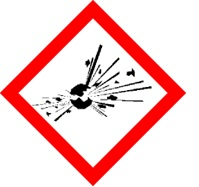 GHS01Exploding bomb
- Signal word
- Danger
Categories and label elements
| CLP abbreviation | Pictogram | Signal word |
|---|---|---|
| Self-react. A | GHS01Exploding bomb | Danger |
Related precautionary statements (P codes)
The precautionary statements that CLP Annex IV assigns to this class. Not all of them go on the label: under CLP Article 28(3), no more than six precautionary statements appear on the label unless the nature and severity of the hazard require more; the selection depends on the product and its users.
Prevention
Response
- P370+P378In case of fire: Use… to extinguish.
- P370+P380+P375In case of fire: Evacuate area. Fight fire remotely due to the risk of explosion.
Storage
Disposal
- P501Dispose of contents/container to …
Build a label with this class. The free label tool works out the pictogram, the signal word and the P statements for the label from the classes you choose.
Where is H240 written in the SDS?
In the SDS, H240 ("Heating may cause an explosion.") first enters Section 2.1 as a classification, written as "Self-react. A" together with the code. Section 2.2 then gives its full text as a label element. Components that have this class are listed row by row in the Section 3 table; in addition, it must agree with the physical and chemical properties in Section 9 and, if the product is subject to transport rules, it is read together with the ADR information in Section 14.
How does H240 appear on the label?
On the label H240 appears with the pictogram GHS01 (exploding bomb), and it is written with the signal word "Danger". In the Chemoris template Section 2.2 carries at most 8 H statements; if the limit is exceeded the least severe ones are dropped and a warning is shown. For the bottom of the label, 10 P statements are candidates for this class in CLP Annex IV; under CLP Article 28 at most 6 of them are selected.
Where does it appear in the safety data sheet?
- Section 2.1: classification; the class abbreviation and H240 are given together.
- Section 2.2: label elements; H240 with its full text, pictogram and signal word.
- Section 3: composition table; in the row of every component that has this class.
- Section 16: the full text of the H statements cited as codes in earlier sections.
Class criteria and thresholds for H240
The values below come from the Chemoris rule file (CLP Annex I). They show the condition under which H240 arises in a mixture. For physical hazards and other classes that depend on test data, the result comes from the mixture's own measurement, not from component percentages.
The class behind H240 depends on the mixture's own test data; the Chemoris rule file does not derive it from component percentages and warns the chemist when a component carries it (≥ 1 %) (CLP Annex I 2.x (for physical hazards 1.1.1.3 / Article 6(5) data requirement); 2.16.3 (metal-corrosive mixture)).
H240 compared with H241 and H242
The table below puts H240 next to its closest neighbouring statements; the values are read from the rule data.
| Hazard statement | H240 | H241 | H242 |
|---|---|---|---|
| Class abbreviation | Self-react. A | Self-react. B | Self-react. CD |
| Pictogram | GHS01 | GHS01, GHS02 | GHS02 |
| Signal word | Danger | Danger | Danger |
| Precautionary statements assigned | 10 | 10 | 10 |
| Concentration cut-off in a mixture | — | — | — |
H240 and H241 carry the same signal word (Danger). The pictogram differs: GHS01 for H240, GHS01, GHS02 for H241. H240 and H242 carry the same signal word (Danger). The pictogram differs: GHS01 for H240, GHS02 for H242.
In which SDS sections does H240 appear?
H240 does not stay only in the label section of an SDS; the class itself and the precautionary statements assigned to it shape the content of other sections too. The counts are calculated from the P statements that Annex IV assigns to this class.
| SDS section | Relation to this code |
|---|---|
| 2.1 Classification | Written with the abbreviation Self-react. A and the code H240. |
| 2.2 Label elements | H240 appears with its full text, GHS01 (exploding bomb) and “Danger”. |
| 3 Composition | The class and code show in the row of every component that carries this class. |
| 9 Physical and chemical properties | The classification has to agree with properties such as flash and boiling point given here. |
| 5 Firefighting | Of the 10 assigned P statements, 2 belong to the subject of this section: P370+P378, P370+P380+P375. |
| 7 Handling and storage | Of the 10 assigned P statements, 6 belong to the subject of this section: P210, P220, P234. |
| 8 Exposure controls / PPE | Of the 10 assigned P statements, 1 belong to the subject of this section: P280. |
| 13 Disposal | Of the 10 assigned P statements, 1 belong to the subject of this section: P501. |
| 16 Other information | The full text of the H statements cited by code is collected here. |
Statements that appear on the label together with H240
H240 is never printed alone on a label; it sits next to the pictogram and the signal word. The Chemoris selection method (response, prevention, storage, disposal in that order; core statements first) gives these first 5 candidates for this class:
| Rank | P code | Type | Priority | Text |
|---|---|---|---|---|
| 1 | P370+P378 | response | core | In case of fire: Use… to extinguish. |
| 2 | P370+P380+P375 | response | core | In case of fire: Evacuate area. Fight fire remotely due to the risk of explosion. |
| 3 | P210 | prevention | core | Keep away from heat, hot surfaces, sparks, open flames and other ignition sources. No smoking. |
| 4 | P220 | prevention | core | Keep away from clothing and other combustible materials. |
| 5 | P234 | prevention | core | Keep only in original packaging. |
The GHS01 pictogram and “Danger” are printed together. This ranking applies because a label usually carries at most 6 statements; when a combined statement is selected, its parts are not printed again.
Official EU wording of H240 in other languages
When a product is exported to the EU, the SDS and label are expected in the official language of the Member State where it is placed on the market (REACH Article 31(5)). The table gives the official wording of H240 from the CLP Annex III/IV language versions published in the Official Journal of the European Union. Source: EUR-Lex CELEX 02008R1272-20260701.
| Language | Official wording | Class title | Signal word |
|---|---|---|---|
| German | Erwärmung kann Explosion verursachen. | Selbstzersetzliche Stoffe und Gemische, Typ A; Organische Peroxide, Typ A | Gefahr |
| French | Peut exploser sous l'effet de la chaleur. | Substances et mélanges autoréactifs, type A; Peroxydes organiques, type A | Danger |
| Spanish | Peligro de explosión en caso de calentamiento. | Sustancias y mezclas que reaccionan espontáneamente, de tipo A; Peróxidos orgánicos de tipo A | Peligro |
| Italian | Rischio di esplosione per riscaldamento. | Sostanze e miscele autoreattive, tipo A; Perossidi organici, tipo A | Pericolo |
| Polish | Ogrzanie grozi wybuchem. | Substancje i mieszaniny samoreaktywne, typ A; Nadtlenki organiczne, typ A | Niebezpieczeństwo |
| Dutch | Ontploffingsgevaar bij verwarming. | Zelfontledende stoffen en mengsels, type A; Organische peroxiden, type A | Gevaar |
| Portuguese | Risco de explosão sob a acção do calor. | Substâncias e misturas auto-reactivas, Tipo A; Peróxidos orgânicos, Tipo A | Perigo |
| Romanian | Pericol de explozie în caz de încălzire. | Substanțe și amestecuri autoreactive, tipul A; Peroxizi organici, tipul A | Pericol |
Common mistakes with H240
- Deriving the class from percentages: H240 cannot be calculated from component percentages; the mixture's own test data is required (CLP Annex I 2.x (for physical hazards 1.1.1.3 / Article 6(5) data requirement); 2.16.3 (metal-corrosive mixture)).
- Pouring every P candidate onto the label: there are 10 candidates, but CLP Article 28(3) limits a label to 6 precautionary statements (up to 8 when needed).
- Writing unlimited H statements for a multi-class product: in the Chemoris template, Section 2.2 holds at most 8 H statements.
Next steps
To read a statement like H240 correctly on a label and in an SDS, see the guide How to read H and P codes; to pick the class and prepare the label automatically, use the free label tool.
Related hazard statements
Other H statements in the same hazard family as H240 (Self-react.). The difference between categories mostly comes from the degree of severity.
Frequently asked questions
Which pictogram and signal word go with H240 on a label?
For H240 the pictogram is GHS01 (exploding bomb); it is written with the signal word "Danger".
How many P statements does H240 need?
CLP Annex IV assigns 10 precautionary statements to the class of H240, but under CLP Article 28(3) a label usually carries at most 6 of them; the selection depends on the product and its user.
In which SDS sections does H240 appear?
H240 appears in Sections 2.1 (classification), 2.2 (label), 3 (composition) and 16, and also in 9, 5, 7, 8 and 13.
What is the difference between H240 and H241?
H240 carries Danger and GHS01; H241 carries Danger and GHS01, GHS02.
Source: Regulation (EC) No 1272/2008 (CLP) Annexes I and III; Turkish SEA Regulation (Official Gazette 28848). The statement is the official English text of CLP Annex III. Pictogram and signal word: CLP Annex I Table 2.8.1. Updated: 6 November 2026.
 Prepare your SDS