
Hazard statement · Health hazards
What does H371 mean?
May cause damage to organs <or state all organs affected, if known> <state route of exposure if it is conclusively proven that no other routes of exposure cause the hazard> .
- Hazard class
- Specific target organ toxicity — Single exposure, Hazard Category 2 (STOT SE 2)
- Pictogram
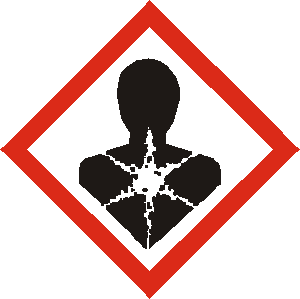 GHS08Health hazard
- Signal word
- Warning
Categories and label elements
| CLP abbreviation | Pictogram | Signal word |
|---|---|---|
| STOT SE 2 | GHS08Health hazard | Warning |
Related precautionary statements (P codes)
The precautionary statements that CLP Annex IV assigns to this class. Not all of them go on the label: under CLP Article 28(3), no more than six precautionary statements appear on the label unless the nature and severity of the hazard require more; the selection depends on the product and its users.
Build a label with this class. The free label tool works out the pictogram, the signal word and the P statements for the label from the classes you choose.
When does a mixture need H371?
For a pure substance H371 comes straight from the classification; for a mixture it is derived from component data. The calculation rules applied to this code are:
- Threshold method: a STOT SE 1 component at ≥ 1 % gives the mixture STOT SE 2 (H371). (CLP Annex I Table 3.8.3)
- Threshold method: a STOT SE 2 component at ≥ 10 % gives the mixture the same class. (CLP Annex I Table 3.8.3)
- If a component has a harmonised specific concentration limit (SCL) and meets it, the mixture takes the corresponding class directly.
For a step-by-step worked example see classifying a mixture under CLP.
Where is H371 written in the SDS?
In the prepared SDS the class "STOT SE 2" is matched with the code in Section 2.1, the text of H371 is written in Section 2.2 next to the pictogram and signal word, and the class of the component shows up in Section 3. Section 16 collects the full text of the H statements cited by code. For H371, it appears in Section 11 (toxicological information), under heading 11.1, as a "Classified" line when the class is among the classes of the mixture.
How does H371 appear on the label?
When you see H371 on a label it is accompanied by GHS08 (health hazard), and it is written with the signal word "Warning". In the Chemoris template Section 2.2 carries at most 8 H statements; if the limit is exceeded the least severe ones are dropped and a warning is shown. For the bottom of the label, 6 P statements are candidates for this class in CLP Annex IV; under CLP Article 28 at most 6 of them are selected.
Where does it appear in the safety data sheet?
- Section 2.1: classification; the class abbreviation and H371 are given together.
- Section 2.2: label elements; H371 with its full text, pictogram and signal word.
- Section 3: composition table; in the row of every component that has this class.
- Section 16: the full text of the H statements cited as codes in earlier sections.
Class criteria and thresholds for H371
The values below come from the Chemoris rule file (CLP Annex I). They show the condition under which H371 arises in a mixture. For physical hazards and other classes that depend on test data, the result comes from the mixture's own measurement, not from component percentages.
| Class | Criterion | Limit / formula | Source |
|---|---|---|---|
| STOT SE 2 | Single-component concentration limit | STOT SE 1 component ≥ 1 % | CLP Annex I Table 3.8.3 |
| STOT SE 2 | Single-component concentration limit | STOT SE 2 component ≥ 10 % | CLP Annex I Table 3.8.3 |
H371 compared with H370 and H336
The table below puts H371 next to its closest neighbouring statements; the values are read from the rule data.
| Hazard statement | H371 | H370 | H336 |
|---|---|---|---|
| Class abbreviation | STOT SE 2 | STOT SE 1 | STOT SE 3 |
| Pictogram | GHS08 | GHS08 | GHS07 |
| Signal word | Warning | Danger | Warning |
| Precautionary statements assigned | 6 | 7 | 7 |
| Concentration cut-off in a mixture | — | — | 1 % |
The signal word differs: Warning for H371, Danger for H370. Both are shown with the same pictogram (GHS08). H371 and H336 carry the same signal word (Warning). The pictogram differs: GHS08 for H371, GHS07 for H336.
In which SDS sections does H371 appear?
H371 does not stay only in the label section of an SDS; the class itself and the precautionary statements assigned to it shape the content of other sections too. The counts are calculated from the P statements that Annex IV assigns to this class.
| SDS section | Relation to this code |
|---|---|
| 2.1 Classification | Written with the abbreviation STOT SE 2 and the code H371. |
| 2.2 Label elements | H371 appears with its full text, GHS08 (health hazard) and “Warning”. |
| 3 Composition | The class and code show in the row of every component that carries this class. |
| 11 Toxicological information | The health effect is justified here under the relevant endpoint heading. |
| 4 First aid | Of the 6 assigned P statements, 1 belong to the subject of this section: P308+P311. |
| 7 Handling and storage | Of the 6 assigned P statements, 4 belong to the subject of this section: P260, P264, P270. |
| 13 Disposal | Of the 6 assigned P statements, 1 belong to the subject of this section: P501. |
| 16 Other information | The full text of the H statements cited by code is collected here. |
Statements that appear on the label together with H371
H371 is never printed alone on a label; it sits next to the pictogram and the signal word. The Chemoris selection method (response, prevention, storage, disposal in that order; core statements first) gives these first 5 candidates for this class:
| Rank | P code | Type | Priority | Text |
|---|---|---|---|---|
| 1 | P308+P311 | response | core | IF exposed or concerned: Call a POISON CENTER/doctor/… |
| 2 | P260 | prevention | core | Do not breathe dust/fume/gas/mist/vapours/spray. |
| 3 | P264 | prevention | core | Wash … thoroughly after handling. |
| 4 | P270 | prevention | core | Do not eat, drink or smoke when using this product. |
| 5 | P405 | storage | core | Store locked up. |
The GHS08 pictogram and “Warning” are printed together. This ranking applies because a label usually carries at most 6 statements; when a combined statement is selected, its parts are not printed again.
Official EU wording of H371 in other languages
When a product is exported to the EU, the SDS and label are expected in the official language of the Member State where it is placed on the market (REACH Article 31(5)). The table gives the official wording of H371 from the CLP Annex III/IV language versions published in the Official Journal of the European Union. Source: EUR-Lex CELEX 02008R1272-20260701.
| Language | Official wording | Class title | Signal word |
|---|---|---|---|
| German | Kann die Organe schädigen < oder alle betroffenen Organe nennen, sofern bekann> < Expositionsweg angeben, sofern schlüssig belegt ist, dass diese Gefahr bei keinem anderen Expositionsweg besteht> . | Spezifische Zielorgan-Toxizität (einmalige Exposition), Gefahrenkategorie 2 | Achtung |
| French | Risque présumé d'effets graves pour les organes <ou indiquer tous les organes affectés, s'ils sont connus> <indiquer la voie d'exposition s'il est formellement prouvé qu'aucune autre voie d'exposition ne conduit au même danger>. | Toxicité spécifique pour certains organes cibles — Exposition unique, catégorie de danger 2 | Attention |
| Spanish | Puede provocar daños en los órganos <o indíquense todos los órganos afectados, si se conocen> <indíquese la vía de exposición si se ha demostrado concluyentemente que el peligro no se produce por ninguna otra vía> . | Toxicidad específica en determinados órganos — Exposición única, categoría 2 | Atención |
| Italian | Può provocare danni agli organi <o indicare tutti gli organi interessati, se noti> <indicare la via di esposizione se è accertato che nessun'altra via di esposizione comporta il medesimo pericolo> . | Tossicità specifica per organi bersaglio (esposizione singola), categoria di pericolo 2 | Attenzione |
| Polish | Może powodować uszkodzenie narządów <podać wszystkie znane narządy, których to dotyczy> <podać drogę narażenia, jeżeli udowodniono, że inne drogi narażenia nie stwarzają zagrożenia> . | Działanie toksyczne na narządy docelowe – narażenie jednorazowe, kategoria zagrożenia 2 | Uwaga |
| Dutch | Kan schade aan organen < of alle betrokken organen vermelden indien bekend > veroorzaken < blootstellingsroute vermelden indien afdoende bewezen is dat het gevaar bij andere blootstellingsroutes niet aanwezig is >. | Specifieke doelorgaantoxiciteit bij eenmalige blootstelling, gevarencategorie 2 | Waarschuwing |
| Portuguese | Pode afectar os órgãos < ou indicar todos os órgãos afectados, se forem conhecidos > < indicar a via de exposição se existirem provas concludentes de que o perigo não decorre de nenhuma outra via de exposição >. | Toxicidade para órgãos-alvo específicos — exposição única, categoria de perigo 2 | Atenção |
| Romanian | Poate provoca leziuni ale organelor <sau indicați toate organele afectate, dacă sunt cunoscute> <indicați calea de expunere, dacă există probe concludente că nicio altă cale de expunere nu provoacă acest pericol> . | Toxicitate asupra unui organ țintă specific – o singură expunere, categoria de pericol 2 | Atenție |
Common mistakes with H371
- Mixing up signal words: if any class requires “Danger”, only “Danger” is printed and “Warning” drops out (CLP Article 20(3)).
- Writing unlimited H statements for a multi-class product: in the Chemoris template, Section 2.2 holds at most 8 H statements.
Next steps
To read a statement like H371 correctly on a label and in an SDS, see the guide How to read H and P codes; to pick the class and prepare the label automatically, use the free label tool.
Related hazard statements
Other H statements in the same hazard family as H371 (STOT SE). The difference between categories mostly comes from the degree of severity.
Frequently asked questions
Which pictogram and signal word go with H371 on a label?
For H371 the pictogram is GHS08 (health hazard); it is written with the signal word "Warning".
How many P statements does H371 need?
CLP Annex IV assigns 6 precautionary statements to the class of H371, but under CLP Article 28(3) a label usually carries at most 6 of them; the selection depends on the product and its user.
When does a mixture need H371?
Threshold method: a STOT SE 1 component at ≥ 1 % gives the mixture STOT SE 2 (H371). Threshold method: a STOT SE 2 component at ≥ 10 % gives the mixture the same class. Details are in the section "When does a mixture need H371?" above.
In which SDS sections does H371 appear?
H371 appears in Sections 2.1 (classification), 2.2 (label), 3 (composition) and 16, and also in 11, 4, 7 and 13.
What is the difference between H371 and H370?
H371 carries Warning and GHS08; H370 carries Danger and GHS08.
Which numerical limits apply to H371 in a mixture?
STOT SE 2: STOT SE 1 component ≥ 1 %; STOT SE 2: STOT SE 2 component ≥ 10 %.
Source: Regulation (EC) No 1272/2008 (CLP) Annexes I and III; Turkish SEA Regulation (Official Gazette 28848). The statement is the official English text of CLP Annex III. Pictogram and signal word: CLP Annex I Table 3.8.4. Updated: 6 November 2026.
 Prepare your SDS