
Contents
In short: REACH Article 31 decides when a supplier must provide a safety data sheet, what it must contain and how it travels down the supply chain. Hazardous substances and mixtures, PBT/vPvB substances and Candidate List substances always need one (Art. 31(1)); some non-classified mixtures need one on request (Art. 31(3)). Registrants who prepare a chemical safety report attach exposure scenarios, which downstream users and distributors must pass on (Art. 31(7)). Where no SDS is required, Article 32 still requires certain information to be passed on.
The SDS as a supply chain document
REACH Title IV is about information in the supply chain. Article 31 is the main vehicle going downstream: every "supplier", whether manufacturer, importer, downstream user or distributor, owes an SDS to its "recipient". Article 34 is the channel going upstream: any actor must tell the next actor up the chain about new information on hazardous properties and anything that calls the risk management measures in the SDS into question. Article 36 requires everyone in the chain to keep the information they need for at least 10 years after they last supplied or used the substance or mixture. This article walks through those duties from the point of view of a company that sits in the middle of the chain. For the language and country questions of exporting into the EU, see SDS for export to the EU.
Which products need an SDS
| Situation | Duty | Legal basis |
|---|---|---|
| Substance or mixture classified as hazardous under CLP | SDS always, no later than first supply | Art. 31(1)(a), 31(8) |
| Substance that is PBT or vPvB (Annex XIII criteria) | SDS always | Art. 31(1)(b) |
| Substance on the Candidate List for other reasons | SDS always | Art. 31(1)(c) |
| Non-classified mixture with a health or environmental hazard substance at ≥ 1 % by weight (≥ 0.2 % by volume for gases) | SDS on request | Art. 31(3)(a) |
| Non-classified mixture with ≥ 0.1 % of a Carc. 2, Repr. 1A/1B/2, Skin Sens. 1, Resp. Sens. 1, lactation, PBT/vPvB or Candidate List substance | SDS on request | Art. 31(3)(b) |
| Non-classified mixture containing a substance with an EU workplace exposure limit | SDS on request | Art. 31(3)(c) |
| Hazardous product sold to the general public with sufficient safety information | No SDS, unless a downstream user or distributor asks | Art. 31(4) |
| Any other substance or mixture | No SDS, but Article 32 information | Art. 32 |
The 0.1 % threshold for Candidate List substances is the one most often missed. A mixture can be unclassified and still trigger the on-request duty because one component was added to the Candidate List. Since the list grows over time, check your formulations against it after each update, and remember that a mixture that is classified needs an SDS anyway.
Content: Annex II and the competent person
Article 31(6) lists the 16 headings, and Annex II sets the content of every subsection. Part A of Annex II, as replaced by Regulation (EU) 2020/878, contains general rules that are easy to overlook:
- Competent person (0.2.3). The SDS "shall be prepared by a competent person" who takes into account the needs and knowledge of the user audience. Suppliers must ensure such persons have received appropriate training, "including refresher training". REACH does not set a certificate for this; the supplier must be able to show the training.
- Plain language (0.2.4). No jargon or abbreviations, and no statements such as "harmless" or "no health effects" that are inconsistent with the classification.
- No blank subsections (0.4). Information is given "where applicable and available", but "the safety data sheet shall not contain blank subsections". Where data are missing, say so and give the reason.
- Consistency (0.1.2 and Art. 31(2)). For a registered substance, the SDS must be consistent with the registration and, where one is required, the chemical safety report.
- Revision marking (0.2.5). A revised SDS shows "Revision: (date)" on the first page, indicates which version it replaces and points out the changes, normally in Section 16.
For a subsection-by-subsection walk-through, see the 16 SDS sections explained.
Extended SDS and exposure scenarios
Registrants of a substance at 10 tonnes or more per year must prepare a chemical safety report (Article 14), and downstream users may have to prepare one under Article 37. Article 31(7) then sets three duties, one per role:
- An actor who prepared a chemical safety report places the relevant exposure scenarios in an annex to the SDS, covering the identified uses. The SDS together with this annex is commonly called an extended SDS (eSDS).
- A downstream user compiling its own SDS must include relevant exposure scenarios and other relevant information from the SDS it received. A formulator cannot simply drop the supplier's scenarios; it must carry the relevant conditions of use into the SDS of its mixture.
- A distributor must pass on relevant exposure scenarios and other relevant information when compiling its own SDS.
Receiving an exposure scenario starts a clock for the downstream user. Article 39 gives 12 months after receiving a registration number in an SDS to comply with Article 37: check that its use is covered and, if not, take one of the routes that article offers, such as informing the supplier or preparing its own chemical safety report.
When no SDS is required: Article 32
A supplier who does not have to provide an SDS under Article 31 is still not silent. Article 32(1) requires it to pass on, free of charge and no later than first delivery:
- the registration number(s), if available, for substances for which information is communicated under the points below;
- whether the substance is subject to authorisation and details of any authorisation granted or denied in the supply chain;
- details of any restriction imposed under Title VIII;
- any other available and relevant information needed to identify and apply appropriate risk management measures.
Article 32(3) applies the same update triggers as Article 31(9), including redistribution to recipients from the previous 12 months.
Delivery and updates
Article 31(8) requires the SDS "free of charge on paper or electronically no later than the date on which the substance or mixture is first supplied". Article 31(5) sets the language: an official language of the Member State where the product is placed on the market. Under Article 31(9), suppliers must update the SDS without delay when new information may affect risk management measures or hazards, when an authorisation is granted or refused, or when a restriction is imposed, and send the revised version to everyone supplied in the preceding 12 months. The update routine is covered in detail in when to update an SDS in the EU, UK and US.
Practical checklist for a formulator
- Keep the current SDS, and any exposure scenarios, of every raw material, with the date received.
- Screen each formulation against Art. 31(1) and 31(3), including the Candidate List at 0.1 %.
- Check that your uses are covered by the scenarios you received, within the Article 39 deadline.
- Record who prepared each SDS and their training, to demonstrate the competent-person requirement.
- Send upstream any new hazard information you obtain (Article 34).
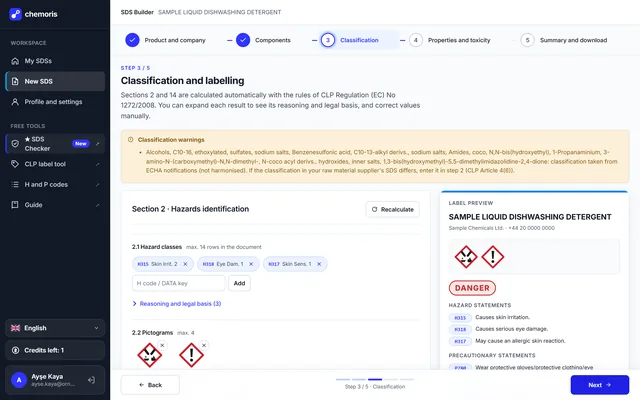
Chemoris builds the SDS from component data and CLP rules, which helps keep Sections 2, 3 and 11 consistent. You can open a free account or check label elements with the free label tool.
Frequently asked questions
Does a non-classified mixture ever need an SDS?
Yes, on request, if it contains one of the substances listed in Article 31(3), for example a Candidate List substance at 0.1 % or more by weight, or a substance with an EU workplace exposure limit.
Must a distributor write its own SDS?
A distributor that supplies the product under its own name compiles its own SDS and must pass on the relevant exposure scenarios and information from the SDS it received (Art. 31(7)). It also supplies the SDS to its own customers under Article 31(1).
Is a certificate needed to be a "competent person"?
REACH Annex II requires competence and appropriate training, including refresher training, but does not itself prescribe a certificate. National rules outside the EU, such as Türkiye's KKDİK, may add one.
This article summarises legal texts for orientation only; it is not legal advice. Check the current consolidated text of REACH before relying on it.
Sources
- REACH, Regulation (EC) No 1907/2006, Articles 14, 31, 32, 34, 36, 37 and 39 and Annex II (consolidated text) — CELEX:02006R1907.
- Commission Regulation (EU) 2020/878 replacing Annex II to REACH — CELEX:32020R0878.
- REACH Articles 31 and 32 as published by legislation.gov.uk — article/31, article/32.
- ECHA, Candidate List of substances of very high concern for authorisation — echa.europa.eu.
Related articles
- Regulation
SDS regulatory calendar 2026-2028: dates that change your safety data sheet
EU dates for SDS in 2026-2028: new CLP hazard classes (ED, PBT, PMT), Annex VI updates, REACH Annex II, UFI and the CLP revision, with legal sources.
- Regulation
Turkish SDS: consultant, software or an in-house KDU?
Three ways to prepare a GBF: a KDU on staff, an external KDU or consultancy, or a KDU plus software. A comparison table, when each makes sense and who stays responsible.
- Regulation
SDS requirements compared: EU REACH, UK REACH and US OSHA HazCom
EU REACH Annex II (2020/878), UK REACH and OSHA HazCom 1910.1200 compared: who supplies the SDS, language, format and update deadlines.
 Prepare your SDS