
Contents
In short: this guide follows one sample mixture through the 16 sections of a safety data sheet (SDS) and shows where each piece of information goes: a liquid dishwashing detergent, H315 and H319, a single pictogram GHS07, the signal word Warning, not a dangerous good for transport. This is sample data, not a real product. For the general explanation, see how to prepare a Turkish SDS.
The sample mixture and its classification
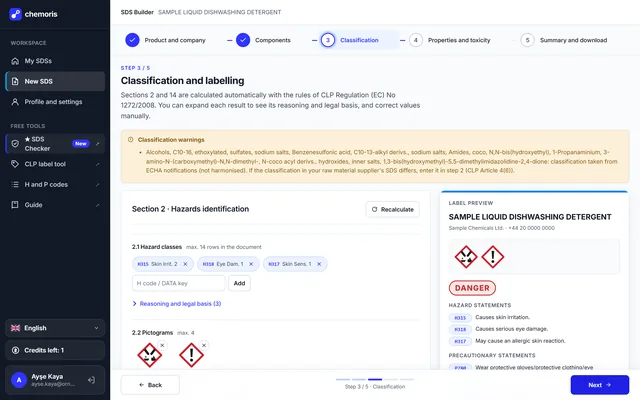
The mixture below comes from Chemoris test data. The product name and the percentages are for demonstration only and do not represent any product on the market. The classification was produced by the tool's own rule engine (CLP mixture rules).
| Ingredient | CAS | % | Class in the test data |
|---|---|---|---|
| SLES | 68585-34-2 | 8 | Skin Irrit. 2 (H315), Eye Irrit. 2 (H319) |
| LAS | 68584-22-5 | 8 | Skin Irrit. 2 (H315), Eye Irrit. 2 (H319) |
| CDEA | 68603-42-9 | 3 | Skin Irrit. 2 (H315), Eye Irrit. 2 (H319) |
| DMDM hydantoin | 6440-58-0 | 0.25 | Acute Tox. 4 (H302) |
| Glycerol | 56-81-5 | 3 | no class |
| Water | 7732-18-5 | 77.75 | no class |
The engine's result: the skin and eye irritants add up to 19 %; because this exceeds the 10 % limit, the mixture is classified H315 and H319 (CLP Annex I, Tables 3.2.3 and 3.3.3). DMDM hydantoin, which carries H302, stays at 0.25 %, below the 1 % cut-off for taking an ingredient into account, so it does not enter the calculation (CLP Annex I, Table 1.1). The pictogram is GHS07 and the signal word is Warning (CLP Article 20(3)). For the principle behind the calculation, see CLP mixture classification.
Sections 1-8: identification, hazards, composition, response
The section titles follow the list of 16 headings in KKDIK Annex 2. For each section we separate "what goes in it" from "what was written in the example". The sections derived from the classification (2, 3, 11, 14) are described directly from the engine output; the others are described in terms of what that output requires.
| Section | What goes in this section? | What was written or determined in the example? |
|---|---|---|
| 1. Identification | Product identifier, use, supplier, emergency telephone number | The product name, use and company details entered by the user; none of it comes from the classification. In this example they are placeholder values. |
| 2. Hazards identification | Classification, label elements, other hazards | Skin Irrit. 2 and Eye Irrit. 2; GHS07; Warning; H315, H319; six precautionary statements: P264, P280, P302+P352, P305+P351+P338, P332+P313, P337+P313. Ingredients that determine the label: SLES, LAS, CDEA. |
| 3. Composition | Ingredients of the mixture, CAS numbers and proportions | The ingredients in the table above; the three surfactants that decide the class stand out. |
| 4. First-aid measures | Response for eyes, skin, inhalation, ingestion; symptoms | The resulting classes point to eye and skin contact; P302+P352 and P305+P351+P338 summarise the response for those two routes. No class resulted for inhalation or ingestion. |
| 5. Firefighting measures | Extinguishing media, special hazards arising from the substance | No flammable liquid class resulted (no flash point was entered); no special fire warning arises from the classification. |
| 6. Accidental release measures | Personal and environmental precautions, clean-up | No aquatic hazard class resulted; the environmental precaution line rests on the user's spill information, not on a class. |
| 7. Handling and storage | Safe handling, incompatibilities, storage | P264 (wash after handling) and P280 (protective gloves and eye protection) are the core of the safe-handling advice. |
| 8. Exposure controls and personal protection | Limit values, engineering controls, PPE | Because of the eye and skin irritation, eye/face protection and gloves stand out (P280). No ingredient with a limit value was entered in this example. |
Sections 9-16: properties, toxicology, transport, regulation
| Section | What goes in this section? | What was written or determined in the example? |
|---|---|---|
| 9. Physical and chemical properties | Appearance, pH, flash point, density, etc. | Physical state "liquid". Because no flash point was entered, no flammability class is proposed; the other values need measurement or supplier data. |
| 10. Stability and reactivity | Stability, conditions to avoid, incompatible materials | No physical hazard class resulted that would change this section. |
| 11. Toxicological information | Effects by hazard class | The skin corrosion/irritation and serious eye damage/irritation rows read "Classified; effect present"; sensitisation, mutagenicity, carcinogenicity, reproductive toxicity, STOT (single and repeated) and aspiration read "Not classified". |
| 12. Ecological information | Aquatic toxicity, degradation, accumulation | No aquatic hazard resulted in the classification; detailed values depend on ingredient data. |
| 13. Disposal considerations | Waste treatment methods | Does not come from the classification; set by the user and local waste legislation. |
| 14. Transport information | UN number, ADR class, packing group, environmental hazard | Not a dangerous good: UN number, ADR class and packing group read "Not classified", environmentally hazardous "No", special precautions "Not dangerous for transport" (ADR 2025, Chapter 2.2). |
| 15. Regulatory information | Safety, health and environmental legislation specific to the product | Classification and label follow CLP; the regulatory references depend on the selected profile. |
| 16. Other information | Revision, abbreviations, full text of H statements | This is where the full wording of H315 and H319 and the form date and revision note appear. |
Lessons from the example
- A below-threshold ingredient still goes on the form. DMDM hydantoin appears in section 3 but has no effect on the class in section 2; the tool's justification line states this explicitly.
- "Not classified" is information too. In section 11 this wording documents that no class resulted.
- Missing data appears as a warning. In this run no ECHA classification was found for glycerol and water, and the tool gave a "check manually" warning; a form should not be signed off before such warnings are reviewed.
- Without a flash point, no flammability class is proposed. For mixtures with a flammable liquid ingredient this value affects sections 2, 9 and 14 together.
When you compare the example with your own product, it helps to follow this order: first verify the ingredient list and percentages in section 3, then check that the classes in section 2 derive from that list, then confirm that sections 11, 12 and 14 are consistent with the same classes. Inconsistency between sections (for example a class in section 2 but "not a dangerous good" in section 14) is among the most common form errors; for details see common mistakes in Turkish SDS.
To learn how to read the label and the H/P codes, see how to read H and P codes.
Codes in this article
Related codes
H and P statements related to this topic; each is explained in the glossary with its full wording, thresholds and label use.
- H220 Extremely flammable gas
- H240 Heating may cause an explosion
- H270 May cause or intensify fire; oxidiser
- H360Df May damage the unborn child. Suspected of…
- P301+P312 IF SWALLOWED: Call a POISON CENTRE/doctor/……
- P302+P335+P334 IF ON SKIN: Brush off loose particles from…
- P303+P361+P353 IF ON SKIN (or hair): Take off immediately…
- P305 IF IN EYES:
- P307
- P311 Call a POISON CENTER/doctor/…
- P331 Do NOT induce vomiting
- P336+P315 Thaw frosted parts with lukewarm water. Do…
- P351 Rinse cautiously with water for several…
- P364 And wash it before reuse
- P372 Explosion risk
- P390 Absorb spillage to prevent material damage
- P422
Related articles
- SDS
How to check a safety data sheet: SDS review checklist in 12 steps
SDS check in three layers: format, consistency between sections, content. A 12-step REACH Annex II review and what to do when a supplier's SDS has errors.
- SDS
SDS consistency check: sections 2, 3, 9 and 14
Do SDS sections 2 and 3 disagree? Section pairs to check for classification, label elements, flash point, ADR transport, limit values and SVHC, with a matrix.
- SDS
How to choose SDS software: 8 criteria to check
How do you choose software to prepare a Turkish SDS? Data source, classification reasoning, regulatory format, Word output, revision and pricing model: an 8-point checklist and the KDU's responsibility.
 Prepare your SDS